The Numbers Behind a Profitable Real Estate Investment
Successful real estate investing begins long before the renovation, the resale, or even the purchase. It begins with knowing your numbers.
Whether you’re a seasoned fix-and-flip investor, a real estate wholesaler, or someone preparing to purchase your first investment property, one of the most important questions you can ask is:
What is the maximum amount I can pay for this property and still achieve my desired profit?
In real estate investing, this is known as your Maximum Allowable Offer (MAO).
Your MAO determines whether an investment opportunity makes financial sense. It establishes your negotiating position, helps protect your profit margin, and reduces your exposure to unnecessary financial risk.
At Surefooted Solutions LLC, we believe successful real estate investing requires more than access to capital. It requires sound financial analysis, reliable property data, thorough due diligence, and a disciplined investment strategy.
Let’s examine how to calculate your MAO and use it to make more informed investment decisions.
1. Establish a Reliable After Repair Value (ARV)
Before determining how much you should pay for an investment property, you must first establish what it could reasonably sell for after renovations are completed.
This is known as the After Repair Value (ARV).
The accuracy of your ARV depends heavily on the quality of your comparable property sales, commonly referred to as comps.
When researching comparable properties, look for:
- Recently sold properties, preferably within the past three to six months.
- Properties within one mile of your subject property, whenever possible.
- Similar square footage, bedroom and bathroom counts.
- Comparable construction styles, property ages, and lot sizes.
- Properties with renovation quality similar to your proposed finished product.
- Similar neighborhood characteristics and buyer demographics.
Whenever possible, keep your comparable sales within a one- to one-and-a-half-mile radius. However, neighborhood boundaries and market similarities are often more important than distance alone.
Expanding your search to five or eight miles may introduce properties from entirely different markets, with different school districts, buyer demand, neighborhood amenities, and property values.
The less reliable your comps are, the greater your investment risk becomes.
Take the Guesswork Out of Property Valuation
At Surefooted Solutions, we offer investors access to Collateral DNA Reports (CDNA), providing valuable property valuation information to assist with investment analysis.
These reports are an affordable resource for evaluating potential acquisitions before committing significant capital, although they are not a substitute for a professional appraisal.
2. Understand the Added Value of a Fully Renovated Property
Not all comparable properties are created equal.
Suppose your research produces three comparable sales indicating an ARV range of $620,000 to $695,000.
Where should your projected resale value fall?
The answer depends largely on the condition of the property after your renovations are completed and how it compares with recently sold homes.
A comprehensively renovated home may command a premium over a comparable property in average condition. One reason is the remaining useful life of its major components.
Consider the difference between a home with older systems and one featuring:
- A newly installed roof.
- Updated HVAC systems.
- Modern kitchen and bathrooms.
- New flooring and windows.
- Updated electrical and plumbing systems.
- Improved exterior appearance and landscaping.
These improvements may reduce the buyer’s anticipated maintenance and replacement expenses, making the property more attractive.
For illustration, if comparable homes in average condition are selling for $620,000, and market evidence supports a 10% renovation premium, the projected ARV would be:
$620,000 × 1.10 = $682,000
However, renovation premiums vary considerably by market. A 10% increase should not be assumed without supporting comparable sales.
The objective is to establish a realistic, defensible resale value—not simply the highest number that makes your investment work on paper.
3. Calculate Your Maximum Allowable Offer
Once you have established your ARV and estimated renovation expenses, you can begin calculating your maximum purchase price.
Many experienced real estate investors use a variation of the 70% rule. A more conservative approach is the 65% rule, which can provide additional room for expenses, risk, and profit.
The Maximum Allowable Offer Formula
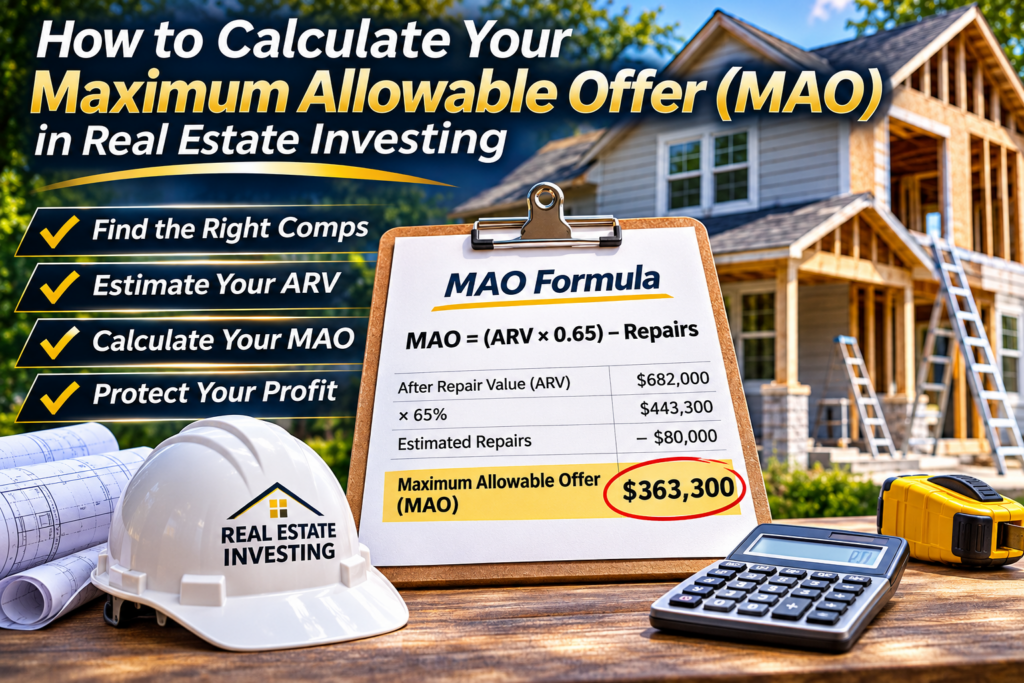
MAO = (After Repair Value × 65%) − Estimated Repair Costs
Let’s apply this formula to an actual investment scenario.
| Investment Calculation | Amount |
|---|---|
| Estimated After Repair Value | $682,000 |
| Investment Multiplier | 65% |
| Adjusted Property Value | $443,300 |
| Estimated Renovation Costs | −$80,000 |
| Maximum Allowable Offer | $363,300 |
Using this formula, your preliminary maximum purchase price would be $363,300.
The remaining 35% of the ARV is intended to provide room for transaction expenses, financing costs, holding costs, unforeseen expenses, and investor profit.
However, the formula is a preliminary screening tool—not a guarantee of profitability.
4. Account for the True Cost of Your Investment
One of the most common mistakes real estate investors make is focusing exclusively on the purchase price and renovation budget.
A profitable investment requires accounting for the entire cost of acquiring, renovating, financing, holding, and selling a property.
These expenses may include acquisition and closing costs, private money loan interest, lender origination fees, insurance, property taxes, utilities, permits, selling commissions, unexpected repairs, and construction delays.
A more comprehensive formula is:
Maximum Purchase Price = ARV − Repairs − All Other Project Costs − Desired Profit
Consider the following example:
| Project Expense | Amount |
|---|---|
| After Repair Value | $682,000 |
| Renovation Costs | −$80,000 |
| Acquisition and Closing Costs | −$8,000 |
| Financing Costs | −$25,000 |
| Holding Costs | −$12,000 |
| Selling and Disposition Costs | −$40,000 |
| Contingency Reserve | −$15,000 |
| Target Investor Profit | −$100,000 |
| Maximum Purchase Price | $402,000 |
In this illustrative example, the detailed calculation supports a maximum purchase price of $402,000, while the more conservative 65% formula suggests $363,300.
The appropriate ceiling depends on your risk tolerance, financing structure, market conditions, and confidence in your renovation budget.
For wholesalers, the desired assignment fee must also be factored into the calculation.
The more accurately you understand your expenses, the better positioned you are to protect your investment.
5. Secure Your Financing Before Making an Offer
Identifying a profitable real estate opportunity is only part of the equation. Having access to the capital necessary to execute the transaction is equally important.
Traditional bank financing may not always accommodate the timelines, property conditions, or investment strategies associated with distressed real estate acquisitions.
Private money financing can provide an alternative for investors who need funding structured around their investment projects.
As a certified private money lender, Surefooted Solutions connects real estate investors with financing solutions for:
- Fix-and-Flip Projects: Funding for purchasing, renovating, and reselling residential investment properties.
- Rehab and Renovation Projects: Capital to acquire and improve properties requiring repairs or modernization.
- Wholesale Transactions: Financing options for qualifying real estate wholesale transactions.
- Residential Investment Properties: Financing opportunities for non-owner-occupied single-family homes and residential properties with up to four units.
Through our network of private capital sources, we work with both new and experienced investors to identify financing solutions that align with their investment objectives.
Our goal is to help you evaluate opportunities, secure appropriate funding, and move forward with confidence.
All financing is subject to underwriting, eligibility, property evaluation, and lender approval.
6. The Word “Maximum” Means Exactly That
Knowing your maximum allowable offer is important. Having the discipline to adhere to it is even more important.
Overpaying for an investment property can eliminate your profit margin before the first renovation even begins.
During negotiations, competitive bidding, or auctions, investors may be tempted to justify paying more by increasing the projected ARV, reducing estimated repair costs, or assuming the property will sell faster than expected.
These assumptions can create unnecessary financial exposure.
Establish your maximum purchase price before entering negotiations. Unless new, verifiable information materially changes your financial analysis, remain committed to that number.
Never allow enthusiasm for a property to override the economics of the investment.
If the seller’s asking price exceeds what your analysis supports, be prepared to walk away.
There will always be another opportunity.
7. Find Motivated Sellers and Off-Market Opportunities
Some of the most attractive real estate investment opportunities can be found before properties are publicly listed on the Multiple Listing Service (MLS).
Identifying property owners who may have a compelling reason to sell can help investors discover opportunities with less competition.
Potential opportunities include:
- Absentee property owners.
- Vacant or distressed properties.
- Properties with substantial equity.
- Owners facing pre-foreclosure.
- Properties with delinquent taxes.
- Owners experiencing multiple circumstances that may motivate a sale.
At Surefooted Solutions, we use advanced AI-powered property research and lead-generation technology to help investors identify potential off-market investment opportunities.
Our property lead services can be tailored to your preferred geographic market, property type, equity requirements, and investment criteria.
Rather than spending countless hours searching for properties that may not meet your requirements, you can focus your efforts on evaluating and pursuing more relevant opportunities.
8. Conduct Thorough Due Diligence Before Committing Capital
A property that appears profitable on the surface may have additional financial or legal complications that affect the transaction.
Outstanding mortgages, secondary loans, tax liens, and other encumbrances can influence your negotiating strategy and the feasibility of an acquisition.
Surefooted Solutions provides several resources designed to support your investment decisions:
Collateral DNA Reports (CDNA)
Property valuation data to help evaluate potential investment opportunities and establish more informed purchase prices.
Debt Stack Reports (DSR)
Available property debt information, including recorded mortgages, outstanding balances where reported, and potential liens. These reports support preliminary due diligence but do not replace a professional title search.
Proof of Funds Letters
Available for eligible investment transactions to help demonstrate financial capability when submitting purchase offers. A proof of funds letter does not constitute a binding loan commitment.
Off-Market Property Leads
AI-powered property research designed to identify potential investment opportunities based on your target market and acquisition criteria.
Private Money Financing
Access to a network of private capital sources supporting qualifying fix-and-flip, wholesale, rehab, and residential investment transactions.
Our objective is to provide more than financing. We strive to be a resource throughout your real estate investment journey.
Frequently Asked Questions
What is the Maximum Allowable Offer (MAO) in real estate?
The Maximum Allowable Offer is the highest purchase price an investor can reasonably pay for a property while accounting for renovation expenses, financing, transaction costs, investment risk, and desired profit.
What is the 65% rule in real estate investing?
The 65% rule is a preliminary investment screening formula calculated by multiplying a property’s estimated After Repair Value by 65% and subtracting projected renovation costs.
MAO = (ARV × 0.65) − Estimated Repairs
It is designed to provide a conservative starting point when evaluating investment opportunities.
What is the difference between the 65% rule and the 70% rule?
The 65% rule provides an additional margin equal to 5% of the property’s ARV. This can be beneficial when dealing with uncertain renovation costs, higher financing expenses, changing market conditions, or wholesale assignment fees.
Neither formula replaces a detailed project analysis.
How close should comparable properties be when calculating ARV?
Ideally, comparable properties should be located within one mile of your subject property. However, the similarity of the neighborhood, property characteristics, renovation quality, and local market conditions should also be considered.
Does a fully renovated property command a higher resale value?
A fully renovated property may command a premium over similar homes in average condition. Updated systems, modern finishes, and reduced anticipated maintenance expenses may increase buyer appeal. The actual premium should be supported by recent comparable sales.
Can private money loans be used for fix-and-flip and rehab projects?
Yes. Private money financing can be structured for qualifying non-owner-occupied investment properties, including fix-and-flip acquisitions and renovation projects. Loan terms depend on the property, borrower qualifications, project economics, and lender requirements.
Know Your Numbers. Secure Your Funding. Build Your Portfolio.
Successful real estate investing is not simply about finding properties. It’s about finding the right properties, purchasing them at the right price, securing appropriate financing, and executing a well-planned investment strategy.
Your Maximum Allowable Offer is the foundation of that process.
At Surefooted Solutions LLC, we are committed to helping real estate investors access the capital, property information, and investment resources they need to make informed decisions.
Whether you’re preparing for your first fix-and-flip project or expanding an established real estate investment portfolio, we welcome the opportunity to become your trusted funding partner.
Have an investment opportunity? Let’s discuss your funding options.
Surefooted Solutions LLC
Certified Private Money Lending | Real Estate Investor Funding
Website: surefootedsolutions.com
Explore Our Services: surefootedsolutions.com/services
Call: 254-978-8354
Happy investing!
Disclaimer: This article is provided for educational and informational purposes only and does not constitute financial, legal, tax, or investment advice. All investment calculations are illustrative. Actual expenses, financing terms, property values, and investment returns may vary. Investors should independently verify all information and conduct appropriate due diligence before committing capital.